Research·Clicks and coverage
Do AI Overviews reduce clicks to websites?
Yes—but the size of the effect depends on the metric, query type, ranking position, citation status, and measurement period.
·11 min read·Markdown
On this page
- What does “AI Overviews reduce CTR” actually mean?
- What did Pew observe in real searches?
- What does Ahrefs’ 58% estimate measure?
- What did Seer find about citations and recovery?
- Are all queries affected equally?
- What is the strongest causal evidence?
- What does “zero-click search” mean here?
- Why do Google’s claims look different?
- How should marketers measure the impact on their own site?
- What is the evidence-based answer for publishers?
- FAQ
- Sources
Summarize with ChatGPTClaudePerplexity
TL;DR
- AI Overviews are associated with fewer traditional organic clicks, but their effect varies by query, ranking, citation status and measurement method.[8][5]
- Pew observed traditional-result clicks on 8% of visits with an AI summary versus 15% without one, while cited summary links were clicked on 1% of summary visits.[3][11]
- Ahrefs estimated a 58% position-one CTR shortfall for AI-Overview keywords against a modeled no-AI-Overview counterfactual.[4]
- A randomized field experiment reported 39.8% fewer outbound organic clicks and 34.5% more zero-click searches when an AI Overview appeared.[2]
- The safest site-level approach is to measure citations, qualified traffic, conversions and revenue alongside CTR rather than applying one universal AI Overview traffic-loss percentage.[7]
Yes—but the size of the effect depends on the metric, query type, ranking position, citation status, and measurement period. The strongest causal evidence currently available reports 39.8% fewer outbound organic clicks when an AI Overview appeared, while observational studies report effects ranging from lower search-result CTR to substantial declines for some non-branded and lower-ranking queries.[1][2]
The evidence does not support a single universal claim such as “AI Overviews reduce website traffic by X%.” Pew measured user actions per search visit, Ahrefs modeled position-one CTR against a counterfactual, Seer compared account-level organic CTR, and the randomized field experiment measured outbound organic clicks conditional on an AI Overview appearing.[2]
At a glance
| Study | Sample | Finding |
|---|---|---|
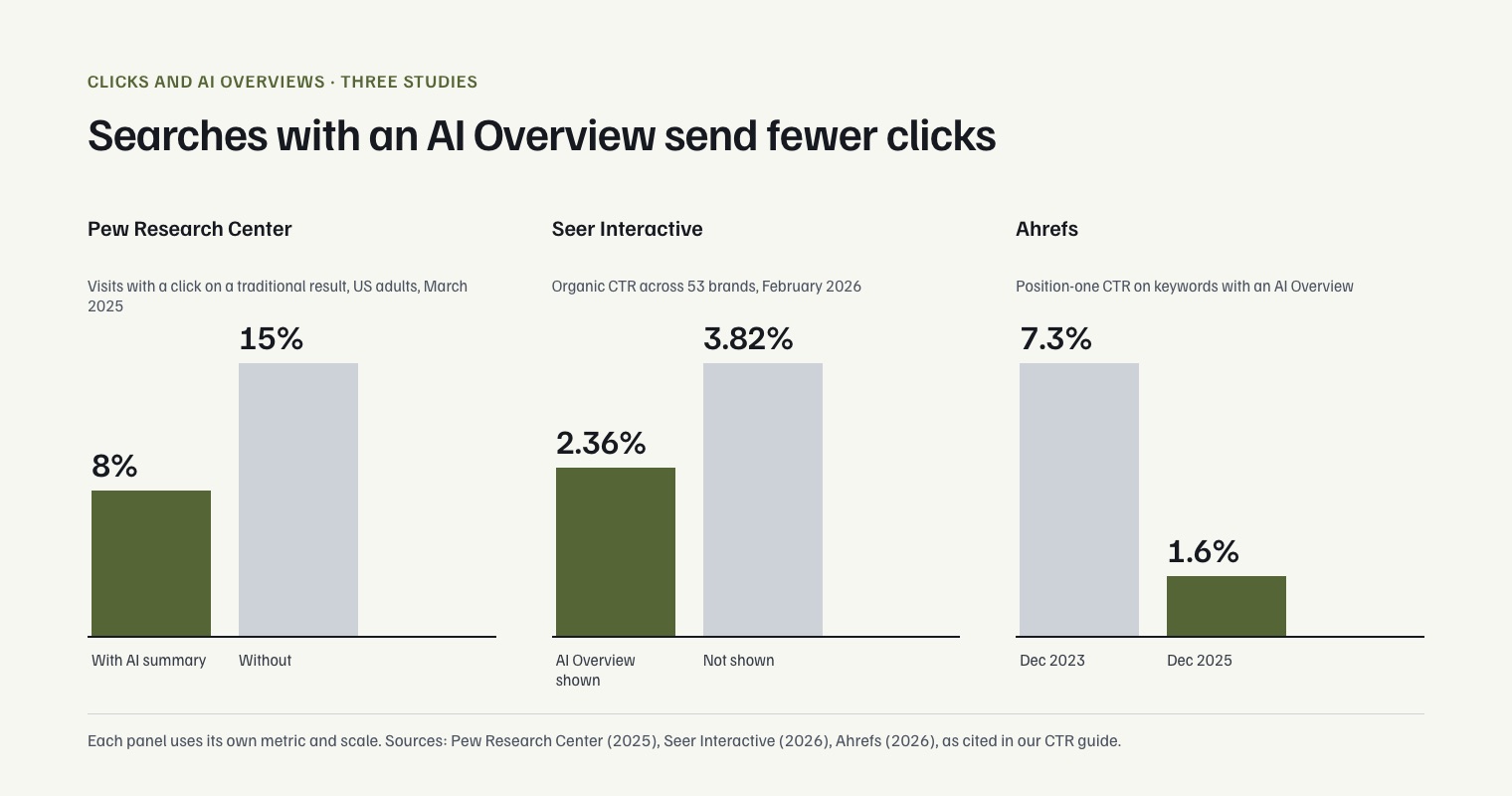
| Pew Research Center | 68,879 Google searches from 900 U.S. adults during March 2025 | Traditional-result clicks occurred on 8% of visits with an AI summary versus 15% without one; cited links inside summaries were clicked on 1% of summary visits.[3] |
| Ahrefs | 300,000 desktop keywords; 150,000 triggered AI Overviews and 150,000 informational comparison keywords did not | Position-one CTR for AI-Overview keywords fell from 7.3% in December 2023 to 1.6% in December 2025; Ahrefs estimated a 58% relative shortfall against a modeled no-AI-Overview counterfactual.[4] |
| Seer Interactive | 53 brands, 5.47 million tracked queries and 2.43 billion organic impressions, January 2025–February 2026 | February 2026 CTR was 2.36% when an AI Overview appeared versus 3.82% when it did not; cited results performed materially better than non-cited results.[5][6] |
| Amsive | 700,000 keywords across 10 websites; focus set of 10,000 AI-Overview-triggering keywords | Average CTR declined 15.49%, but branded queries rose 18.68% while non-branded queries declined 19.98%.[7] |
| Agarwal and Sen field experiment | Randomized Google Search experience for U.S. desktop users | Outbound organic clicks fell 39.8% when an AI Overview appeared, while zero-click searches rose 34.5%.[2] |
| BrightEdge | AIO visibility, size and citation-overlap data from February 2025–February 2026 | AI Overview presence increased from roughly 30% to 48% of tracked queries, but the report did not publish a CTR estimate.[8] |
What does “AI Overviews reduce CTR” actually mean?
CTR is the percentage of impressions that produce a click. It is not the same as clicks per search visit, total website sessions, or revenue per visitor.
This distinction matters because different studies use different denominators:
- Search-visit behavior: Pew recorded whether a user clicked a traditional result during a search-result-page visit.[3]
- Search Console CTR: Seer compared organic clicks with impressions across large brand cohorts.[5]
- Rank-specific CTR: Ahrefs focused on position-one CTR and compared observed results with a modeled counterfactual.[4]
- Experimental outbound clicks: Agarwal and Sen measured whether users clicked through to an external organic website when randomly assigned to search pages with or without AI Overviews.[2]
A lower CTR can therefore coexist with stable aggregate traffic if impressions increase, query demand changes, rankings improve, or AI-Overview visitors become more likely to convert. Conversely, a modest CTR decline can produce a large traffic loss for a site that depends heavily on affected queries.
Google itself says users coming from AI-feature results may be more engaged and spend more time on destination sites, but its guidance does not provide a quantified AI-Overview CTR lift or reduction.[9] Google has also said total organic click volume from Search was relatively stable year over year and that average click quality increased slightly; this is an aggregate claim, not an AI-Overview-specific comparison.[10]
What did Pew observe in real searches?
Pew Research Center analyzed browsing activity from 900 U.S. adults during March 2025, covering 68,879 unique Google searches. An AI-generated summary appeared on 12,593 of those searches.[3]
Users clicked a traditional search result on 8% of visits with an AI summary, compared with 15% of visits without one. A link cited inside the AI summary was clicked on only 1% of summary visits.[3][11]
Pew also found that users ended their search session on 26% of pages with an AI summary, compared with 16% of pages without one.[11][3] That pattern is consistent with more searches ending without a traditional-result click, but it does not prove that the AI summary caused the difference.
Pew’s study is observational. It does not randomly assign users to pages with and without AI Overviews, and it measures clicks per search-page visit rather than the CTR of a particular website or ranking position.[1]
Why Pew is still useful
Pew’s value is behavioral realism. The study observes what people actually did in Google rather than inferring clicks from rankings or modeling a counterfactual.
Its limitations are equally important:
- The sample represents the panel’s tracked devices and searches, not every Google user.[11]
- The study covers Google Search, not AI search behavior generally.[1][5]
- The 8% versus 15% comparison is an association, not a randomized causal estimate.[11]
- The result is not equivalent to a publisher’s Search Console CTR.[4][12]
What does Ahrefs’ 58% estimate measure?
Ahrefs compared 150,000 keywords that triggered AI Overviews with 150,000 informational keywords that did not. It used aggregated desktop Google Search Console CTR data and compared December 2023 with December 2025.[4]
For the AI-Overview keyword cohort, position-one CTR declined from 7.3% to 1.6%. Ahrefs modeled what CTR might have been without the AI Overview and estimated a 58% relative shortfall for the top-ranking result.[4]
That is a large estimate, but it should not be described as a universal 58% traffic loss. It is:
- A position-one estimate rather than an all-ranking average.
- Based on a modeled no-AI-Overview counterfactual.
- Correlational rather than randomized.
- Influenced by broader changes in Google Search behavior and SERP composition.[13]
The comparison cohort also declined, from 7.6% to 3.9% over the same broad period.[5][7] That decline shows why a before-and-after comparison without a control group could overstate the effect attributable specifically to AI Overviews.
What did Seer find about citations and recovery?
Seer Interactive analyzed 53 brands, 5.47 million tracked queries and 2.43 billion organic impressions from January 2025 through February 2026.[6][5]
In February 2026, organic CTR was 3.82% when no AI Overview appeared and 2.36% when one appeared.[6] Seer also reported that AI-Overview-present CTR rose from approximately 1.3% in December 2025 to 2.4% in February 2026—an 85% rebound.[6]
The study’s most useful finding is that citation status matters. Seer reported that being cited increased organic clicks per impression by 120% compared with not being cited, although cited AI-Overview impressions still underperformed the no-AI-Overview cohort by 38%.[5]
This produces a more nuanced picture:
- An AI Overview can reduce clicks to traditional listings overall.[7]
- A citation can improve the outcome for the cited site relative to an uncited competitor.[11]
- A cited site may still receive fewer organic clicks than it would without an AI Overview.[8][6]
- CTR can change substantially as Google changes the format and placement of AI Overviews.[14]
Seer’s methodology has limitations. AI-Overview status was a static label from the latest SERP snapshot applied retrospectively, which weakens time-specific attribution. Seer also states that its analysis supports correlation rather than causation, and its projections used a 12-month 2025 OLS trend without a seasonality adjustment.[5]
Are all queries affected equally?
No. The available studies consistently point to heterogeneous effects.
Amsive reported an average CTR decline of 15.49% across its focus set, but the segments moved in different directions. Branded AI-Overview-triggering queries rose 18.68%, while non-branded queries declined 19.98%. Queries ranking outside the top three declined 27.04%, and queries showing both an AI Overview and a Featured Snippet declined 37.04%.[7]
These findings suggest several practical differences:
- Branded searches may retain stronger click intent because users already seek a known company or product.[5]
- Non-branded informational searches may be more exposed to answer substitution.[5][1]
- Lower-ranking pages may lose more because the AI Overview occupies attention before users reach traditional results.[8][1]
- Multiple answer features may intensify the zero-click pattern.[7]
Amsive’s exact observation window, baseline dates, sampling procedure and statistical testing were not published in the cited article.[1] Its percentages should therefore be treated as vendor-reported directional evidence, not as a fully reproducible causal estimate.
What is the strongest causal evidence?
A randomized field experiment by Saharsh Agarwal and Ananya Sen assigned users to standard Google Search with AI Overviews or to a version where AI Overviews were removed when triggered.[13][2]
The revised abstract reports that, conditional on an AI Overview appearing, outbound organic clicks fell 39.8% and zero-click searches increased 34.5%. It reports no measurable difference in downstream-site engagement conditional on a click, and no improvement in perceived search quality or ease of finding information.[2]
The experiment is more informative about causality than account-level comparisons because users were randomly assigned to different search experiences. However, the accessible SSRN abstract does not disclose the sample size, recruitment method or intervention duration.[11]
A secondary account describes 1,065 U.S. desktop-Chrome participants, a two-week test per participant during January and February 2026, three conditions and preregistration. Those design details should be attributed to the secondary account rather than the abstract itself.[1][11]
The result also has a narrow interpretation: a 39.8% reduction in outbound organic clicks when an AI Overview appeared is not automatically a 39.8% reduction in every publisher’s monthly traffic. The effect applies to the experiment’s users, queries and exposure conditions, and it is conditional on an AI Overview being triggered.[7]
What does “zero-click search” mean here?
A zero-click search is a search session in which the user does not click an external result. The user may stop after reading the AI Overview, refine the query, click another Google feature, or leave without visiting a website.
The randomized experiment found a 34.5% increase in zero-click searches when an AI Overview appeared.[13] Pew likewise found that traditional-result clicks occurred less often on visits with AI summaries, while cited summary links received clicks on only 1% of summary visits.[3]
Zero-click growth does not mean that every search produces no value for publishers. Some users may later return directly, search for a brand, or visit a cited source through another route. However, those later actions are not captured by a simple organic CTR comparison.
Why do Google’s claims look different?
Google’s public statements focus on aggregate traffic, click quality and the ability of AI features to link to original sources. Google says clicks from pages with AI Overviews can be higher quality because users may spend more time on the destination.[9][1]
Google has also said total organic click volume from Search was relatively stable year over year and average click quality increased slightly.[10] That statement covers Google Search overall, not a controlled comparison of AI-Overview and non-AI-Overview impressions.
Google’s Search Console announcement for generative-AI performance reporting describes visibility data such as impressions and the URLs appearing in AI responses. It does not publish a comparative AI-Overview CTR or click-lift figure.
These claims are not necessarily direct contradictions:
- Vendor studies often isolate queries where an AI Overview appeared.[5][1]
- Google’s statement concerns aggregate Search behavior across a much broader population.[1][8]
- Google’s “quality click” framing emphasizes post-click engagement, while CTR measures whether a click happened.[1][5]
- Aggregate traffic can remain stable while some sites or query groups lose clicks.[10]
How should marketers measure the impact on their own site?
A site-level analysis should avoid relying on a single overall CTR number. Use a segmented before-and-after analysis that keeps the denominators consistent.
- Separate AI-Overview and non-AI-Overview queries. Compare impressions, clicks and CTR for matched query groups rather than mixing all Search Console traffic.
- Segment by brand intent. Report branded and non-branded queries separately because their effects can differ substantially.[5]
- Segment by ranking position. A site ranking first may experience a different change from a site ranking below the top three.[3][11]
- Track citation status. Record whether the site is cited in the AI Overview, because citation can improve clicks relative to non-citation.[5]
- Measure conversions and revenue. Google recommends evaluating conversions and other visit value rather than clicks alone.[5]
- Monitor landing-page engagement. Compare qualified sessions, engagement, leads and purchases, not only impressions and CTR.
- Account for seasonality and algorithm changes. A before-and-after result can reflect demand shifts, rankings, product changes or Google updates rather than AI Overviews alone.[5]
- Report absolute and relative changes. A move from 1% to 0.8% is a 20% relative decline but only 0.2 percentage points in absolute terms.
- Preserve the observation window. Record when AI-Overview presence was measured and whether the label was observed contemporaneously or applied retrospectively.[5]
- Compare cited and uncited pages. Visibility inside the answer may matter even when traditional-result CTR declines.[7]
What is the safest way to report an AI Overview CTR result?
State the population, dates, denominator, comparison group and limitation in the same sentence. For example: “In Seer’s 53-brand dataset, organic CTR was 2.36% on impressions with an AI Overview versus 3.82% without one in February 2026; the account-level comparison indicates an association, not a randomized causal effect.”[5]
Avoid converting that result into a universal traffic forecast. A site’s outcome can differ according to query mix, ranking, brand demand, citation status, device, geography and conversion behavior.[5]
What is the evidence-based answer for publishers?
AI Overviews generally reduce the probability of a traditional organic click when they appear, but the effect is not constant across searches or websites.[7][1]
The evidence is strongest when presented as a range of study-specific findings:
- Pew observed traditional-result clicks on 8% of visits with an AI summary versus 15% without one.[3]
- Ahrefs estimated a 58% position-one CTR shortfall against a modeled no-AI-Overview counterfactual.[4]
- Seer measured February 2026 CTR of 2.36% with an AI Overview versus 3.82% without one, while finding that citations improved performance relative to non-citation.[5]
- Amsive reported a 15.49% average decline, with branded queries rising and non-branded queries falling.[7]
- The randomized field experiment reported 39.8% fewer outbound organic clicks when an AI Overview appeared.[13]
The practical conclusion is not simply “optimize for clicks.” Publishers should measure whether their pages are cited, whether qualified AI-referred traffic converts, and whether brand demand, direct traffic or returning visits compensate for lower traditional-result CTR. Measuring conversions is harder than it looks: Finseo’s review of six studies on AI search attribution reports that analytics records only about 1 in 10 AI-driven conversions, and it describes a post-purchase survey that closes the gap.
Frequently asked questions
Do AI Overviews reduce website traffic?
They often reduce traditional organic clicks when an AI Overview appears, but the effect on total website traffic varies by site and query mix.[7] A site can lose clicks from affected searches while gaining impressions, branded demand, direct visits or higher-value visitors from the clicks that remain.[9]
What percentage of clicks do AI Overviews take away?
There is no single reliable percentage for every website. The randomized field experiment reported 39.8% fewer outbound organic clicks when an AI Overview appeared, while Ahrefs estimated a 58% position-one CTR shortfall against a modeled counterfactual; these figures use different samples and methods.[4][2]
What did Pew find about AI Overview click-through rates?
Pew found that users clicked a traditional result on 8% of visits with an AI summary, compared with 15% of visits without one.[3] Links cited inside the summary were clicked on 1% of summary visits, and the study was observational rather than randomized.[11]
Do citations in AI Overviews increase clicks?
Citation can improve a site’s performance relative to not being cited. Seer reported that cited impressions produced 120% more organic clicks per impression than non-cited AI-Overview impressions, although cited impressions still underperformed impressions without an AI Overview by 38%.[5]
Are branded searches affected less than informational searches?
Some evidence suggests branded searches can be more resilient. Amsive reported an 18.68% increase for branded AI-Overview-triggering terms but a 19.98% decline for non-branded terms in its focus set.[7] The result comes from one vendor study with incompletely disclosed methodology, so it should not be generalized to every brand.[11][5]
How should a site measure AI Overview traffic impact?
Separate queries by AI-Overview presence, brand intent, ranking position and citation status, then compare clicks, CTR, qualified sessions, conversions and revenue.[5][7] Keep the dates and denominators visible, account for seasonality and algorithm changes, and avoid treating a study-level percentage as a forecast for the entire site.[5]
Sources
- 1The impact of generative AI search result design on user perceptions and information adoption | Proceedings of the 2026 Conference on Human Information Interaction and Retrieval — dl.acm.org
- 2The Impact of Google AI Overviews on Publisher Traffic and User Experience: Evidence from a Field Experiment by Saharsh Agarwal, Ananya Sen :: SSRN — papers.ssrn.com
- 3Do people click on links in Google AI summaries? | Pew Research Center — pewresearch.org
- 4Update: AI Overviews Reduce Clicks by 58% — ahrefs.com
- 5AIO Impact on Google CTR: 2026 Update — seerinteractive.com
- 6Google AI Overviews CTR shows early signs of recovery: Study — searchengineland.com
- 7Google AI Overviews: New CTR Study Reveals How to Navigate Negative SERP Impact | Amsive — amsive.com
- 8AI Overviews at the One-Year Mark: Presence, Size, and What They’re Citing | BrightEdge — brightedge.com
- 9Top ways to ensure your content performs well in Google's AI experiences on Search | Google Search Central Blog | Google for Developers — developers.google.com
- 10AI in Search: Driving more queries and higher quality clicks — blog.google
- 11Investigating Click Behaviors On Google Search Result Pages That Produce an AI Overview — arxiv.org
- 12AI Overview CTR Fell 61%, But Clicks Didn’t Collapse — searchenginejournal.com
- 13Study Confirms Google AI Overviews Cut Organic Clicks 38% — searchenginejournal.com
- 14How To Optimize Your Visibility In Google AI Overviews | Similarweb — similarweb.com