Buyer's guide·Choosing a tracker
How accurate are AI Overview trackers, and how can you test one?
Measure tracker accuracy separately for Overview presence, answer fidelity and citation URL fidelity, rather than reducing it to one score.
·12 min read·Markdown

On this page
Summarize with ChatGPTClaudePerplexity
TL;DR
- AI Overview tracker accuracy should be measured separately for Overview presence, answer fidelity, and citation URL fidelity rather than reduced to one score.[13]
- Location, language, device, account state, expansion behavior, collection method, and check time can make two apparently identical searches produce different results.[8]
- STAT and Nozzle document HTML retention, while SE Visible describes browser-based collection and unedited responses; buyers should still request query-level metadata and artifacts.[22]
- Independent studies report changing answers and cited URLs, so a citation mismatch is not automatically a tracker error without matched timing and context.[23][22]
- The safest 2026 buying test is a fixed-query trial with manual screenshots, citation-URL comparison, repeated runs, and separate precision and recall scores.
Are AI Overview trackers accurate? They can be useful, but “accuracy” is not a single measurement. A tracker may correctly detect that an AI Overview appeared while capturing different answer text, missing citations revealed after expansion, or recording a different set of source URLs.[1]
The most reliable buying decision comes from a matched trial: compare tracker results with manual Google searches using the same query, location, language, device, account state, and approximate check time. Record screenshots, answer text, and citation URLs, then score Overview presence and citation fidelity separately.[2][3]
What does AI Overview tracker accuracy mean?
For buyer evaluation, separate accuracy into three questions:
- Presence accuracy: Did the tracker correctly report whether an AI Overview appeared?
- Answer fidelity: Did it capture substantially the same visible answer as the manual search?
- Citation fidelity: Did it identify the same source URLs, including sources visible only after expansion?
Published tests measure different targets, including brand-mention detection, overlap between collection methods, answer stability, cited-link overlap, and disagreement between AI Overviews and Featured Snippets. Those measures cannot be combined into one universal accuracy score.[4]
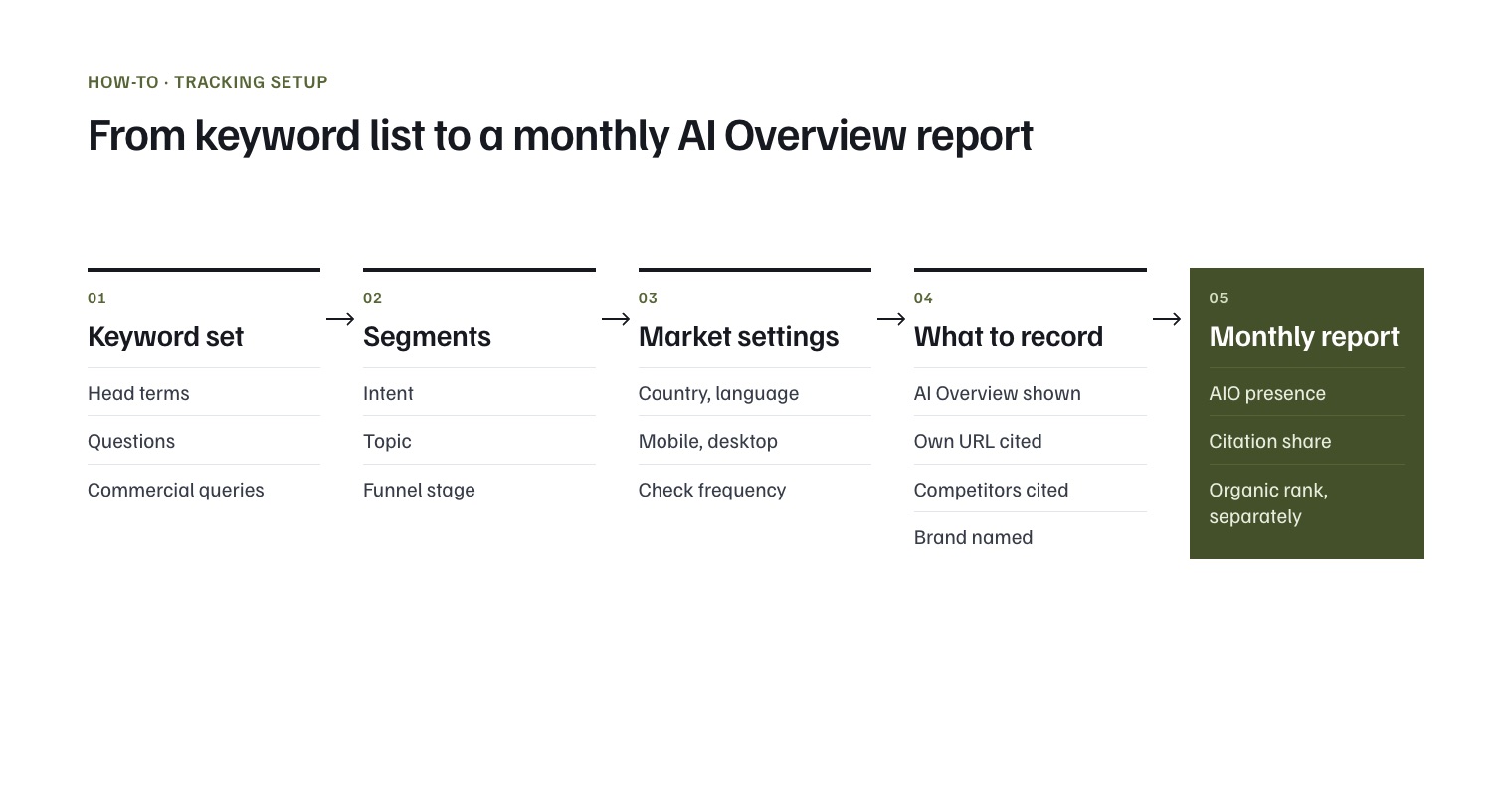
For each query and run, create a manual record containing:
- Whether an AI Overview appeared.
- The visible answer text.
- Citation URLs visible before expansion.
- Additional citation URLs after expansion.
- Location, language, device, account state, timestamp, and browser conditions.
Use that manual result as the comparator for the same conditions, not as a permanent ground truth. Google documents that Search results can vary with location, device, current searches, and language, while independent research finds that AI Overview answers and citations can also change over time.[5][6]
Presence should be reported with precision and recall, not only an overall accuracy percentage. Precision measures how often a tracker’s positive reports are correct; recall measures how many of the AI Overviews present in the manual sample the tracker detected. Google’s machine-learning guidance warns that overall accuracy can mislead when positive and negative cases are unevenly distributed.[7]
The same approach applies to citations. Compare the tracker’s URL set with the manual URL set and report exact matches, missing URLs, and extra URLs separately.
Why can AI Overview results differ?
AI Overview tracking data quality depends partly on the search context used to collect it. A tracker may be technically consistent while measuring a different SERP from the buyer’s manual check.
| Factor | Why results differ | What to ask the vendor |
|---|---|---|
| Location | Google says location can affect Search results, even when personalization is disabled. City-level differences may matter for local queries.[6][8] | Can the tracker target a country, city, postcode, or precise location? Is the location applied to the AI Overview request itself? |
| Language | Google documents that language settings and localized results can produce variations.[5] | Which interface and query language are used? Are answer language and search-interface language recorded separately? |
| Device | Desktop and mobile SERPs can display different layouts, availability, answer lengths, and citation treatments. Several vendors document device-specific tracking generally, but not always for AI Overviews specifically.[9][10] | Is device emulated for AI Overview collection? Can buyers compare desktop and mobile? |
| Logged-in state | Account state and personalization can change the Search environment. BrightEdge documentation has described both logged-in and later logged-out AI Overview conditions at different points.[3] | Is collection logged in, logged out, or incognito? Is the state fixed and documented for every run? |
| Search history | Current searches and account history can influence Search context; Google separately documents personalization for AI Mode when relevant settings are enabled.[8] | Are cookies, account history, and personalization disabled? Is a clean browser profile used? |
| Check time | AI Overviews can change between runs. Research reports citation turnover, answer-decision flips, and low overlap in retrieved links across observations.[6] | What is the collection timestamp and time zone? Can the vendor provide the exact run time? |
| Expansion state | The initial Overview may show fewer citations than an expanded panel. A tracker that captures only the collapsed state can undercount sources.[3] | Does the tool record the initial state, expanded state, or both? |
| Collection route | Browser rendering, API access, emulated searches, and stored SERP HTML can expose different content. A comparison found different overlap between manual, UI-scraping, and DIY/API methods.[10] | Is the result collected through a real browser, an API, a rendered SERP, or another method? |
| Query interpretation | Small changes in punctuation, spelling, language, or query wording can alter whether an Overview appears and what it contains.[11][6] | Does the platform preserve the exact submitted query, including punctuation and capitalization? |
| Data refresh | Daily, weekly, keyword-database, and ad hoc refreshes do not represent the same observation schedule.[12] | How often is each query checked, and is the displayed result tied to a specific run? |
Google’s official guidance establishes that Search context matters, but it does not prescribe one universal crawler identity or one fixed AI Overview capture method. Buyers should therefore treat context fields as essential measurement metadata.[13][14]
AI Overviews and AI Mode should also be treated as separate products. Google says they may use different models and techniques, so a tracker for one cannot automatically be assumed to reproduce the other.[10]
What do vendors disclose about collection?
Vendor transparency is uneven. The strongest documentation describes not only the dashboard output but also the artifact retained behind it.
- STAT documents full SERP HTML and lists topic, language, location, and device for AI Overview tracking. Its historical product note described logged-out observations and pre-expanded AI Overviews, but that does not establish the current default for every query.[15]
- Nozzle says it stores each SERP with raw HTML and shows examples of pre-expanded and post-expanded views. Its documentation does not establish that every production capture automatically expands every Overview.[16]
- SE Visible describes browser-based retrieval of real responses, storage of unedited responses, daily tracking by default, and one check per prompt per location. It does not publish all device, login, expansion, screenshot, or timestamp details.[14]
- Semrush documents location and device settings for Position Tracking and daily AI Overview tracking, but the reviewed pages do not publish the full screenshot-versus-HTML method, login state, expansion policy, or exact check time.[9]
- Ahrefs describes locale and coverage in Brand Radar and stores raw responses, but the precise response format, device setting, login state, expansion behavior, and exact collection time are not published in the reviewed documentation.[17]
- seoClarity offers AI Overview snapshots and image comparisons across dates. Its general ranking API documents location and device coverage, but does not establish that those settings govern AI Overview capture.[16][6]
- AccuRanker describes AI Overview presence and keyword trends, while its general rank-tracking documentation covers local targeting and refresh options. The reviewed pages do not confirm that those general settings apply to AI Overview collection.[17][6]
- SISTRIX documents weekly AI Overview data, country coverage, SERP archives, and cited URLs, but not the current login state, expansion behavior, raw artifact format, or exact check time.[17][6]
- BrightEdge has conflicting historical signals: an older help page described logged-in US AI Overviews, while a later company post described a rollout involving non-logged-in users. Neither source supplies a complete current collection recipe.[8]
- Finseo is excluded from this general comparison because the article focuses on vendor-neutral testing rather than ranking or recommending a particular platform.
The distinction between “not documented” and “not supported” matters. If a vendor does not publish its login state or expansion policy, that does not prove the tool cannot control those variables. It means the buyer should request evidence before assuming reproducibility.
A useful vendor response should include a sample query-level record with:
- Exact query.
- Country and local location.
- Search and answer language.
- Device and browser.
- Logged-in or logged-out status.
- Timestamp and time zone.
- Expansion state.
- Captured answer.
- Complete citation URL list.
- Screenshot or raw HTML, where available.
How should you compare trackers?
Compare the capture process, not just the dashboard’s totals. A dashboard may report the number of AI Overviews, cited domains, or brand mentions without showing whether the underlying observations were collected under conditions comparable with your own searches.
Use three evaluation layers:
1. Presence detection
Check whether the tracker and manual search agree that an AI Overview exists. Record:
- True positives: both methods report an Overview.
- False positives: the tracker reports one, but the manual check does not.
- False negatives: the manual check shows one, but the tracker does not.
Then calculate precision and recall. This reveals whether a platform tends to over-report or miss Overviews.
2. Answer fidelity
Compare the visible answer rather than requiring identical wording. AI-generated answers may be paraphrased or change slightly while preserving the same meaning. Record whether the tracker captured:
- The same conclusion.
- The same brand or entity mentions.
- The same qualifying statements.
- The same answer sections or bullet points.
- Any material omissions or additions.
Do not treat semantic similarity as proof that every citation is correct. Ahrefs reported high average semantic similarity while also reporting substantial pointwise change and only partial URL overlap.[1]
3. Citation fidelity
Compare URLs at the page level where possible. Report:
- Exact URL matches.
- Same domain but different page.
- Citations missing from the tracker.
- Citations added by the tracker.
- URLs visible only after expansion.
Citation turnover is normal enough that a mismatch needs time and context metadata before it can be classified as a tracker error. A 2026 study reported 18% overlap in retrieved AI Overview links across observations, while another longitudinal analysis reported 54.5% average URL overlap between observations.[6][1] Finseo’s own German-language (DACH) analysis of about 1.4 million answers found that only 31.6% of URLs cited in Google AI Overviews were still cited the next day for the same prompt; see how stable AI citations are in German-language search.
What does independent research show?
Existing comparisons provide useful signals, but none establishes a universal best AI Overview tracker.
A GTECH test of 12 AI-visibility platforms used 600 manually verified prompt-answer pairs over four weeks. It reported 81% average mention-detection accuracy, a 67%–94% range, and 9% of reported mentions as false positives; nine platforms covered AI Overviews. Because the result was pooled across engines and focused on mention detection, it is not an AIO-only score or a complete ranking of tracker accuracy.[4][13]
A Contengi study repeated one query across three Google collection methods, with 10 repetitions per method. It reported 63.1%–64.9% pairwise overlap for AI Overview brand presence between a manual method and other methods, 70.7% manual self-overlap, and 82.4% overlap between DIY/API and UI-scraping methods. These are overlap measures rather than correctness against an independent ground truth, and the one-query design limits generalization.[4]
A Cloro industry test compared four of seven tools across 50 queries using the same US geolocation with personalization disabled. Mention counts converged within 5%, but similar counts do not prove that tools detected the same Overviews or cited the same URLs.[13]
Research on Google’s own variability reinforces the need for a matched trial:
- An ACL Findings 2026 study reported 18% overlap in AI Overview retrieved links and answer-decision flips of 17% over a short interval and 16% over 24 hours for the reported binary-answer comparison.[6]
- Ahrefs analyzed more than 43,000 keywords with at least 16 observations per keyword over a month and reported a 70% pointwise change rate, 2.15-day average persistence, 54.5% average URL overlap, and 0.95 cosine similarity in answer semantics.[1]
- A GEO Lab case rendered one query 10 times, with nine completed renders; the tested page appeared in six results and was absent in three. This demonstrates possible variation but cannot estimate general prevalence.[17]
- A peer-reviewed AAAI ICWSM study of 1,508 baby-care and pregnancy queries found disagreement between AI Overviews and Featured Snippets in 33% of cases where both appeared. That is not a repeated-run AI Overview accuracy rate.[13]
The practical conclusion is conditional: a tracker should be judged on the outcomes that matter to the buyer and on whether it exposes enough evidence to reproduce or audit each observation.
What should a trial protocol include?
Use this short protocol when evaluating an AI Overview tracker before signing.
- Freeze the query panel. Select a fixed set of queries covering the business’s topics and query types. Record exact spelling, punctuation, language, and target market, and do not replace queries during the trial.
- Record the search context. For every run, capture country, city or other location, language, device, browser, login state, cookie state, and personalization settings. Keep tracker and manual conditions identical. Google documents variation associated with location, device, current searches, and language.[5]
- Run a matched manual check. Search each exact query manually within a narrow time window around the tracker’s observation. Save a screenshot before expanding the Overview and a second screenshot after expansion when possible.
- Save citation URLs. Record every source URL visible in the collapsed state and every additional URL revealed after expansion. Do not rely only on domain names or a dashboard’s citation count.
- Repeat the same panel. Run a second round under the same conditions. If results change, check whether the manual SERP also changed before treating the difference as a tracker defect. Research documents both answer variation and citation turnover.[18]
- Score three outcomes separately. Calculate presence precision and recall, assess answer fidelity, and compare citation URL sets. Report exact matches, missing URLs, and extra URLs rather than one blended score.[17]
- Request the vendor’s run metadata. Ask for the exact query, location, language, device, account state, timestamp, time zone, expansion state, and stored screenshot or HTML. Mark undisclosed fields as Not published.
- Set acceptance thresholds before reviewing results. Agree with the business owner what level of missed Overviews, false positives, answer divergence, and citation mismatch is acceptable. No reviewed study establishes a universal threshold for every buyer.
A trial spreadsheet should include these columns:
| Query | Manual AIO present | Tracker AIO present | Answer match | Manual citation URLs | Tracker citation URLs | Exact URL matches | Context and time |
|---|
The aim is not to force identical results from every system. It is to establish whether differences are explained by changing SERPs, mismatched collection conditions, incomplete expansion, or an actual capture problem.
Why can two AI Overview trackers disagree on the same keyword?
Two trackers can query the same keyword but use different locations, languages, devices, browser profiles, login states, timestamps, or expansion rules. They may also collect through different routes, such as browser rendering, API access, or stored SERP HTML. Because Google Search context and AI Overview content can change across runs, disagreement does not identify the faulty tracker by itself; compare the run metadata, screenshots, answer text, and citation URLs first.[3]
What evidence should buyers request before purchase?
Ask vendors to demonstrate one query from beginning to end rather than showing only an aggregate dashboard.
The demonstration should show:
- The exact query submitted.
- The selected location and language.
- The device or emulation profile.
- Whether the request is logged in or logged out.
- The collection timestamp and time zone.
- The initial AI Overview.
- The expanded AI Overview.
- All citation URLs.
- The stored screenshot, HTML, or raw response.
- The refresh schedule and whether the displayed result is the latest observation.
Prefer tools that make the observation inspectable. STAT and Nozzle explicitly document HTML retention, while SE Visible describes browser-based collection and unedited responses. Those features improve auditability, but they do not prove that the tool used the same context as a buyer’s manual search.[8][4]
Be cautious when documentation describes only general rank-tracking settings. A platform may support country, device, or refresh controls for ordinary rankings without confirming that those settings govern AI Overview collection. The vendor should explain the AIO-specific implementation rather than relying on a generic feature list.[19]
Finally, distinguish historical documentation from current behavior. BrightEdge’s reviewed materials describe changing logged-in and logged-out conditions, and SE Ranking’s legacy AI Results Tracker is limited to accounts subscribed before October 29, 2026, with SE Visible presented as the current route for new users.[20][2]
Frequently asked questions
Are AI Overview trackers accurate?
They can accurately detect many AI Overview observations, but available research does not establish one universal accuracy score or winner. Accuracy should be split into presence detection, answer fidelity, and citation URL fidelity, then tested against manual searches under matched conditions.[6][13]
What affects AI Overview tracking data quality?
Location, language, device, login state, search history, expansion state, collection time, and collection method can all affect comparability. Google documents general Search variation by location, device, current searches, and language, while independent studies report changes in answers and cited URLs across observations.[5]
How do you test an AI Overview tracker?
Use a fixed query set, record identical search conditions, pair tracker runs with manual searches, save before-and-after-expansion screenshots, and compare citation URLs. Repeat the panel and calculate precision and recall for Overview presence rather than relying on a single aggregate accuracy number.[4][13]
Should an AI Overview tracker store screenshots?
Screenshots or raw HTML make individual observations easier to audit, but storage alone does not prove accuracy. The artifact should be accompanied by the query, location, language, device, account state, expansion state, and timestamp so the observation can be interpreted and reproduced.[3][21]
Why can citation counts change when the answer looks the same?
AI Overview answers can remain semantically similar while their supporting URLs change. Ahrefs reported high semantic similarity alongside substantial pointwise change and partial URL overlap, while other research also found turnover in retrieved links.[1]
Is a manual Google search a perfect ground truth?
No. A manual search is a comparator for a specific query, context, and moment, not an invariant answer for every user or market. The most useful test matches the tracker’s conditions as closely as possible and records the time and context of both observations.
Sources
- 1AI Overviews Change Every 2 Days (But Never Change Their Mind) — ahrefs.com
- 2How to use AI Results Tracker: Rankings – Knowledge Base — help.seranking.com
- 3AI Overview Citation Variance: 6 Cited, 3 Absent in 10 Identical Renders — thegeolab.net
- 4We Tested 12 AI Visibility Tracking Tools: Accuracy Compared — gtechme.com
- 5Personalization & Google Search results - Google Search Help — support.google.com
- 6Characterizing Web Search in the Age of Generative AI — aclanthology.org
- 7Classification: Accuracy, recall, precision, and related metrics | Machine Learning | Google for Developers — developers.google.com
- 8Auditing Google’s AI Overviews and Featured Snippets: A Case Study on Baby Care and Pregnancy — arxiv.org
- 9How to Track AI Overviews with Semrush — semrush.com
- 10LLM tracking accuracy report: DIY tracker vs UI scraping vs manual — contengi.com
- 11AI Overviews - SISTRIX — sistrix.com
- 12Rank Tracking API | seoClarity — seoclarity.net
- 13AI Overview Tracking Tools: 7 Options Compared | cloro — cloro.dev
- 14How to Add Keywords — accuranker.com
- 15STAT Knowledge Base | AI Overviews: Now on logged-out SERPs and in… — help.getstat.com
- 16AI Overviews: Measuring the Impact on SEO — seoclarity.net
- 17Ahrefs Brand Radar Methodology: How we collect and model AI visibility data — ahrefs.com
- 18Frequently Asked Questions | seoClarity — seoclarity.net
- 19STAT Knowledge Base | Changes to how AI Overviews are ranked in STAT — help.getstat.com
- 20Setting up a project for AI Results Tracker – Knowledge Base — help.seranking.com
- 21Configuring Position Tracking | Semrush Knowledge Base — semrush.com
- 22SE Visible: AI Visibility Platform by SE Ranking — visible.seranking.com
- 23How to Track AI Overviews: Mentions, Citations, Click Loss, and the Traffic Google Won't Show You — ahrefs.com